Or there's a particualrly good collection of on-line HP Lovecraft writings at Project Gutenberg Australia. (Just scroll down to find him under the authors with the last name "L.")
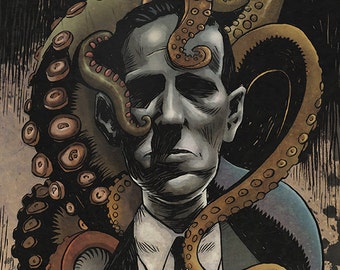
HP Lovecraft is normally classified as a weird horror writer but I think a good argument could be made that often he could be classified as a science fiction writer. I think this story is one example. It's a bit long but it is a classic. It dates from 1931.
(As an aside, I mentioned that I wrote my MA Thesis on the search for Peking Man, a colloquial term for some specimens of Homo Erecti found in China in 1927. Let me suggest, it's never a bad idea to check and verify when people make claims of lofty education, etc. Although I strongly believe most people are honest and good --if you lose your wallet it usually gets returned-- it only takes one dishonest or predatory person to complicate and change your life, so in that spirit: https://ecommons.cornell.edu/handle/1813/8399
This is my MA Thesis. There is no obligation whatsoever to read any of it. Really.
Damon Runyon
Since we are discussing pulp and magazine fiction of the 1930s and 1940s, I'd like to introduce you to Damon Runyon. Damon Runyon is not a science fiction writer and has absolutely no business being mentioned in this class. On the other hand, he's great. He's very, very funny and often considered one of the masters of the craft of short story writing.
So check him out. I have found his story "A Piece of Pie" and if you look at it, I think you will enjoy it.
Next week in honor of the release of Blade Runner 2049, a sequel to Blade Runner which is based on the novel "Do Androids Dream of Electric Sheep?" by Philip K Dick, we'll skip ahead and talk about Philip K Dick.
We plan to read "Beyond lies the wub" which is in the book.
If you prefer to read it online, it's easily available online.
Please be aware that the movies tend to slide away from the philosphical aspects of the work and more into action but that's the nature of movies.
There are a lot of good documentaries and biographical materials available on Philip K Dick. The challenge for this class was to find one that was short ehough so that it did not take up all our class time.
Here's some more biographical material on Philip K Dick.
This is an interesting discussion of the film adaptations of Philip K Dick
However, this is the best documentary I have seen yet on Philirp K Dick. Unfortunately, it's an hour long so we won't be watching it in class, but I definitely recommend you take a look at it if you have the time.
Philip K Dick is a very interesting and controversial writer. In class, I will very quickly share some thoughts on Philip K Dick that came from Stephen Miller, a science fiction writer. Miller and his wife, Sharon Lee, are very nice people who write a space opera series set in what they call "The Liaden Universe." Their website is here: http://korval.com/ Their work is very, very different from Philip K Dick's. In the above documentary, "Phiiip K Dick, A Day in the Afterlife," Thomas Disch is featured prominently. He is a science fiction writer who also wrote an interesting book on science fiction called The DREAMS OUR STUFF IS MADE OF: How Science Fiction Conquered the World. Although the book is far reaching and discusses many things, Philip K Dick is often discussed in it and in many contexts https://www.amazon.com/DREAMS-OUR-STUFF-MADE-Conquered/dp/0684859785/ref=sr_1_fkmr0_1?s=books&ie=UTF8&qid=1507927248&sr=1-1-fkmr0&keywords=disch+stuff+our+dreams+are+made+of
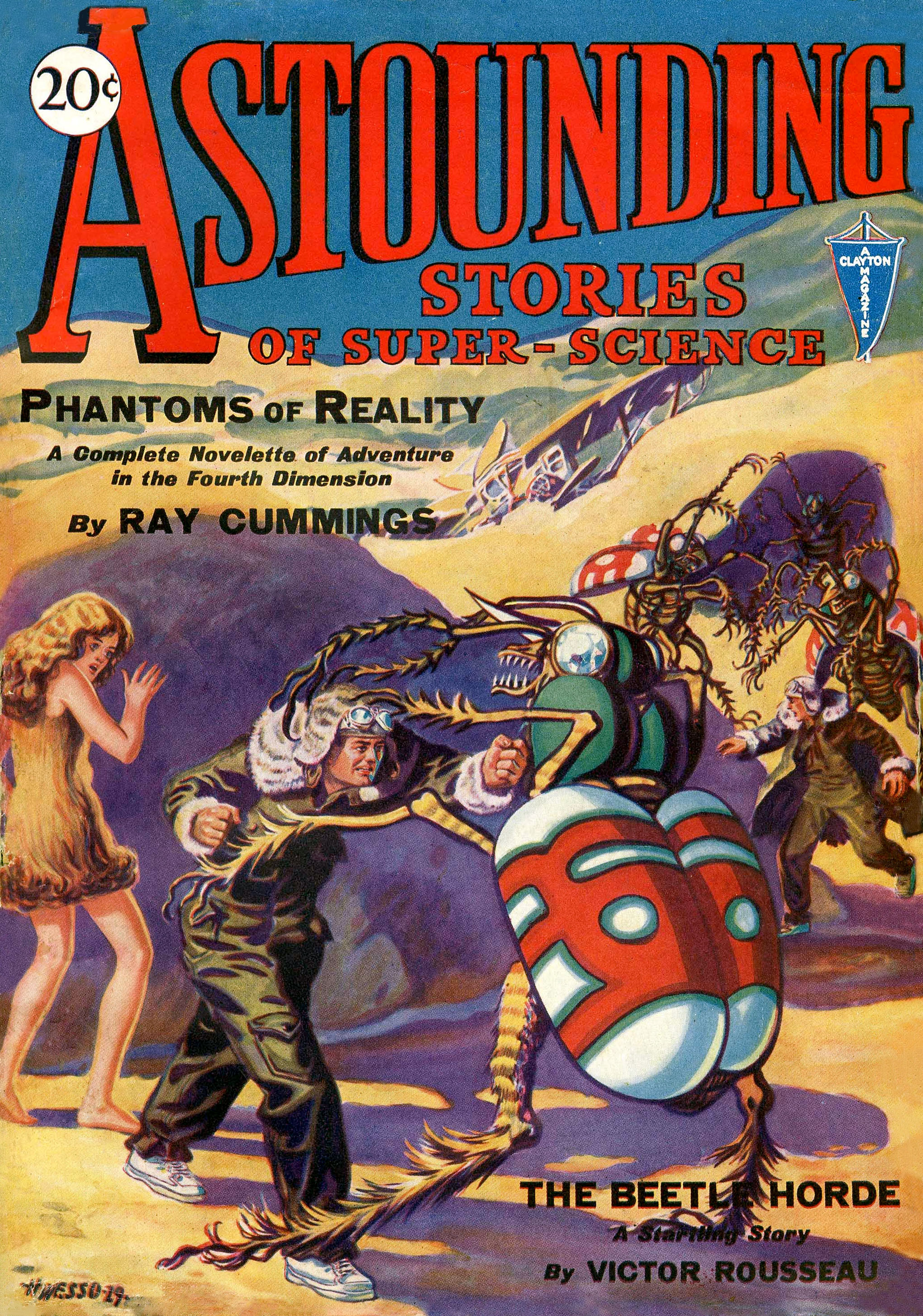
We will also continue our discussion of pulp stories and early magazine stories with Leslie F Stones "Conquest of Gola" --this is in the book but if you wish to see the actual magazine it came in (with editorials and other stories, as well as fascinating ads, you may look here:
Finally, I'd be curious to get your take on the issue of Edgar Rice Burroughs and sexism or lack thereof.
There are ten and a half books in ERB's "Barsoom" (Mars) series, easily his most popular series after Tarzan and his most popular SF series.
This is the fourth one and dates from 1916. In the first three books, John Carter, a master swordsman and civil war veteran comes to Mars (Barsoom) through mysterious means where he discovers that due to the low gravity he has super strength. Skipping ahead, he makes friends with the savage four armed green martians who soon capture him and then rescues Dejah Thoris, a proud Barsoomian princess from a nation called Helium. They get married and have a son named Carthoris (should you wonder, Tarzan and Jane got married and had a son name Korak).
In this book, Carthoris, now an adult, meets Thuvia, a proud Martian princess who has the power to control the Martian lions called "Banths" and well . . . problems happen and he sets out to rescue her.
Just read as much as you want but please try to read at least the first scene of the book. (It starts much faster than the first three. I think in the first one, it takes a couple chapters before John Carter gets to Mars, chapters in which ERB carefully explains how he met John Carter and acquired the manuscript and in which John Carter explains how he wound up on Mars after going to Arizona where he was chased by Apaches into some mysterious ruins that transported him to the red planet.
Jules Verne 1828-1905 "Voyage Extroadinaire" / Extraordinary Voyages French adventure writer who enjoyed writing stories that include a technological wonder
Because students often did not attend class, and the text book was not appropriate to their reading level, I made an effort to provide the materials required in a way that the students could access them any time and any place they might wish. Fortunately youtube offers a wealth of such materials.
Since part of learning to do academic writing, or any sort of writing for that matter, is to choose an appropriate topic and develop it in an appropriate way, I devoted a class to that topic.
When it comes to research paper topics, there's a lot of fine materials out there and here are some of my favorities.
As with most writing topic, the Purdue Owl contains useful materials:
I recently had the chance to teach a non-credit class on science fiction at the local engineering school. Of course, I accepted. And, although we've only completed three weeks I am enjoying myself and so are the students, I think.
Class #1 was devoted to the question of "Can one define what science fiction is?" and "What is the first Science Fiction story?"
I don't claim it's a definitive answer, but I chose Mary Shelley's Frankinstein as my answer.
This entertaining and well done video includes much on that subject, although I prefer to stop the video at about the point roughly half way through where the SPOILERS on this classic novel (much different from the films) start:
Mary Shelley's Frankenstein (as well as Pollidori's much forgotten but highly influential novel, "The Vampyre.") were written on a particularly wild weekend by a group of decadent Bohemians including Lord Byron, the poet, and Mary's husband Shelley, another decadent, wild poet.
I'd heard there was a movie based on this weekend and the events that occurred. To my surprise, I learned there were two. interestingly, they were made only two weeks apart. "Haunted Summer" and "Gothic" --interestingly I stumbled across a bizarre looking film called "Liztomania" that was also produced by Ken Russel, producer of "Gothic."
Although "Liztomania," had nothing but nothing to do with anything related to the class, save for some bizarre science fiction imagery, I showed it to the students and they seemed to enjoy it.