Showing posts with label Teaching English. Show all posts

Sunday, November 26, 2017

APA format


Here are some introductory materials to help teach the APA format. The APA format is a standard format used in academic writing.


http://psych.utoronto.ca/users/reingold/courses/resources/handouts_apa/Citing1.pdf


Introduction to cause and effect essay and paragraph writing


Here are a few videos that help teach writing about cause and effect.

This one is on how to write a cause and effect paragraph.


These are on how to write cause and effect essays. There are many others on the web as well, but they tend to be long.


Writing a Five Paragraph Essay

Here are some materials I've collected for help in learning to write five paragraph essays. I used these when teaching English 101 at the proprietary college.


http://www.edb.utexas.edu/minliu/pbl/ESOL/index.htm


https://owl.english.purdue.edu/owl/resource/685/05/

Simple cause and effect videos

 These are a few videos I've collected to help explain cause and effect. Many are designed for children, but they do a good job of getting the basic idea of what one is talking about before moving on to more advanced vocabulary. 


Wednesday, November 8, 2017

paraphrasing, quotation, and citation -an excellent video


Not much here to share, but the little I do have is quite good. At some point, it seems, most of my writing classes do get the opportunity to watch this video.


It's got one of the best explanations I've seen on how to teach students to write original work without plagiarizing while still using the necessary key words that are required to share the ideas in the source.

Saturday, October 28, 2017

English speaking Rhythm --English sounds without meaning. Right on!! -And that crazy Italian song that sounds like English but isn't.


In the last two posts, I spoke about teaching English rhythm to students in order to improve their spoken English pronunciation.

To help get this concept across even further, I offer this --one of the greatest things on the internet!! (At least to an English as a Second Language teacher.)

Adriano Celantano is an Italian comedian who created a song that sounds like an American English song but consists of nothing but nonsense words with English sounds and rhythm. I've included two versions of the video of the song. The first has just the song. The second has the Italian language set up that frames the joke and explains the song. Basically, if you can understand the Italian, students in an Italian music class ask their teacher how one can sing a foreign, English language song if you forget the words. Is it possible? He assures them that it is and then demonstrates.


English speaking rhythm and Hip Hop


Language has rhythm and different languages have different natural rhythms.

When students (or other humans) learn a new language, to speak it well, they need to learn to speak it with the appropriate rhythm. Each language, and often different dialects of the same language, have distinct stress patterns. People who wish to learn to speak a second or addtional language need to learn to speak it with an appropriate rhythm.

But before they can do this, they must become familiar with the concept of language rhythm and how to recognize it in different languages.

Hip Hop is a form of music where people speak in rhythm. Therefore it seems a natural tool for exposing students to the idea that different languages have different rhythm.

Therefore, for that purpose, I have collected a wide variety of hip hop videos in different languages to use in class.

The students should be told that American hip-hop videos often contain bad or impolite language and non-standard or poor grammar as well as sometimes offensive subject matter. It is not always a good tool to teach English but it is a good tool to teach rhythm.

PLEASE NOTE --I HAVE NOT WATCHED EACH AND EVERY ONE OF THESE VIDEOS FROM BEGINNING TO END. ALSO I DO NOT SPEAK ALL THESE LANGUAGES. THEREFORE IF YOU FIND OR HEAR SOMETHING THAT IS OFFENSIVE IN ONE OF THESE VIDEOS OR THAT YOU THINK I SHOULD KNOW ABOUT ON ONE OR MORE OF THESE VIDEOS, PLEASE MESSAGE ME AND LET ME KNOW OR PUT SOMETHING IN THE COMMENTS BELOW IF YOU PREFER. I WILL TRY TO ADDRESS THE ISSUE WHEN IT HAPPENS.

Although they are primarilly in other languages, often there are parts where the rappers rap in English. This is useful because it can be used to show the different accents and how the sounds and rhythm of their first language carries over into the second language, English. (The Burmese and Karen one are particularly good for this.)

On the other hand, the English sections, in standard hip hop fashion, often include offensive Engish language and students should be warned (it's best not to play some of these videos if your students will be offended by "the F word" or other offensive words.) So be warned.

Also, and an additional warning, it is the nature of hip-hop videos that they often contain sexy young women dressed in skimpy clothes who are objectified and treated as prizes. Although I've tried to minimize such images, it is the nature of hip-hop videos that such depictions of women will be found here. Now, honestly, I would prefer it if the videos showed depictions of brainy women (who are also healthy and nice to look at) doing impressive things that are beneficial for society but I did not make these videos I just collected them. If the usual depictions of women as often depicted in hip-hop offend you or your students, consider playing these videos without the images.

As stated above, if you find something that is considerably offensive, please let me know either by private message of in the comments below and I will do my best to attend to it.

English

First, Mr Wendall by Arrested Development, a clean video with a nice message.


If you listen to the rhythm of the words, there is sort of a "one TWO one TWO one TWO one TWO DAP DAP DAP" rhythm to much of the speech.


Queen Latifah is another example of English language with a hip-hop that has a good message.

(And for the record, yes, they are both old. I am NOT using hip-hop in the classroom to show how cool and "with it" I am. I gave up on that long ago. I am using hip-hop to teach the concept of rhythm in language and to stress that when a language student learns to speak a new language they should strive to change their speaking rhythm to match the rhythm of the new language, not the old language.)


This video shows samples from hip hop videos in Mandarin and Vietnamese, two very different but "isolationist" languages where the rhythm is more monosyllabic and does not change to the same extent as in English.


Although they switch back and from English to their own language, making the contrast in rhythm particularly noticeable, the rhythm is more of repetitive "bop-bop-bop-bop-bop" as they speak . *

Japanese and Korean 

Japanese and Korean have their own rhythm that is distinctly different from Chinese or Vietnamese. Even if you don't know a single word of the languages then you can easily learn to distinguish them through the rhythm.

This one is in Russian

Russian 


This one is in Mexican Spanish.


By comparing these two, students who do not know either Spanish or Russian should be able to learn to distinguish between the two -And be able to do so without knowing a single word of the language.


Punjabi 


Swahili 


Turkish 


Cambodian hip hop (starts about 1:15pm) 


Burmese 

I thought this one was particularly good for explaining the concepts.

Notice how his English sounds like his Burmese. 


Karen song

The Karen are a hill tribe that lives primarilly on the Thai-Burmese border. There is a lot of fighting in the region as many Karen wish to split off and form an independent state and the Burmese government resists this. Therefore many Karen have come to the USA and other Western nations as refugees. I have several Karen friends and acquaintances which is one reason I included this video which was made in the USA.


Navajo

I went to youtube looking for Navajo language hip-hop. Lo and behold, I found some. 


Lest the students become confused about whether or not Native American Indians speak English or not, here's some English language Native American hip hop from the Navajo reservation (although the rapper is half Sioux by ethnicity/)   


Tibetan 


I enjoy the Taiwanese rapper MC Hot Dog. He was big at one point when I lived on the island, so of course, I had to include him here.


English speaking rhythm videos

Languages have a thythm, each and every one of them. And this rhythm varies from one language to the next. When people learn a second (or additional) language, they have a tendency to speak with the rhythm of the first language. For this reason, it's a good to teach them not only that spoken American English has a distinct  rhythm and stress pattern, but what that rhythm is.

Fortunately, like so much else, Youtube has a wealth of videos on how English should be spoken. 

The following are some of my favorites.  I offer them without other comment.


Thursday, October 26, 2017

FANBOYS and compound sentences


This is  fun video that teaches about compound sentences.

It also teaches the useful acronym FANBOYS

For
And
Nor
But
Or
Yet
So


This also teaches the FANBOYS acronym and compound sentences.


Grammar Rock --Conjunction Junction --same thing, different era.


writing good sentences

More than once I've been hired to teach writing to students who often needed help with the basics.

This is a collection of materials I've found on the basics of writing good sentences.


This second one is good too, but it's worth mentioning that Mark Roberts is Canadian and pronounces the word "pasta" differently than most Americans would. (We would say PAH-sta,  with an "a" like in "taco" but he says PA-sta with an "a" like in "cat.")


Sentence fragments are a big problem with many students, both foreign and native speakers.


Run on sentences are another big problem.


If you'd like to practice corrrecting sentences and check your understanding of grammar, here is a collection of sample quizzes and practice sheets you can use.

http://www.englishforeveryone.org/Topics/Sentence-Correction.htm


This video teaches types of sentences.


This is a video on how to write better sentences. It assumes a good command of grammar.


Not so great


https://www.youtube.com/watch?v=xpoZBnXHg3E


Thursday, October 12, 2017

Pete Teaches Science Fiction --Class #3

The Early Magazines  --

"The Pulps" 


This site provides an excellent introduction to the "pulp" magazines that were such an important part of early science fiction: https://mail.google.com/mail/u/0/#inbox/15f12ccdc5ad3bc9

While there, do not hesitate to browse and explore the archives. Many of the early pulp magazines are on the web in different places.


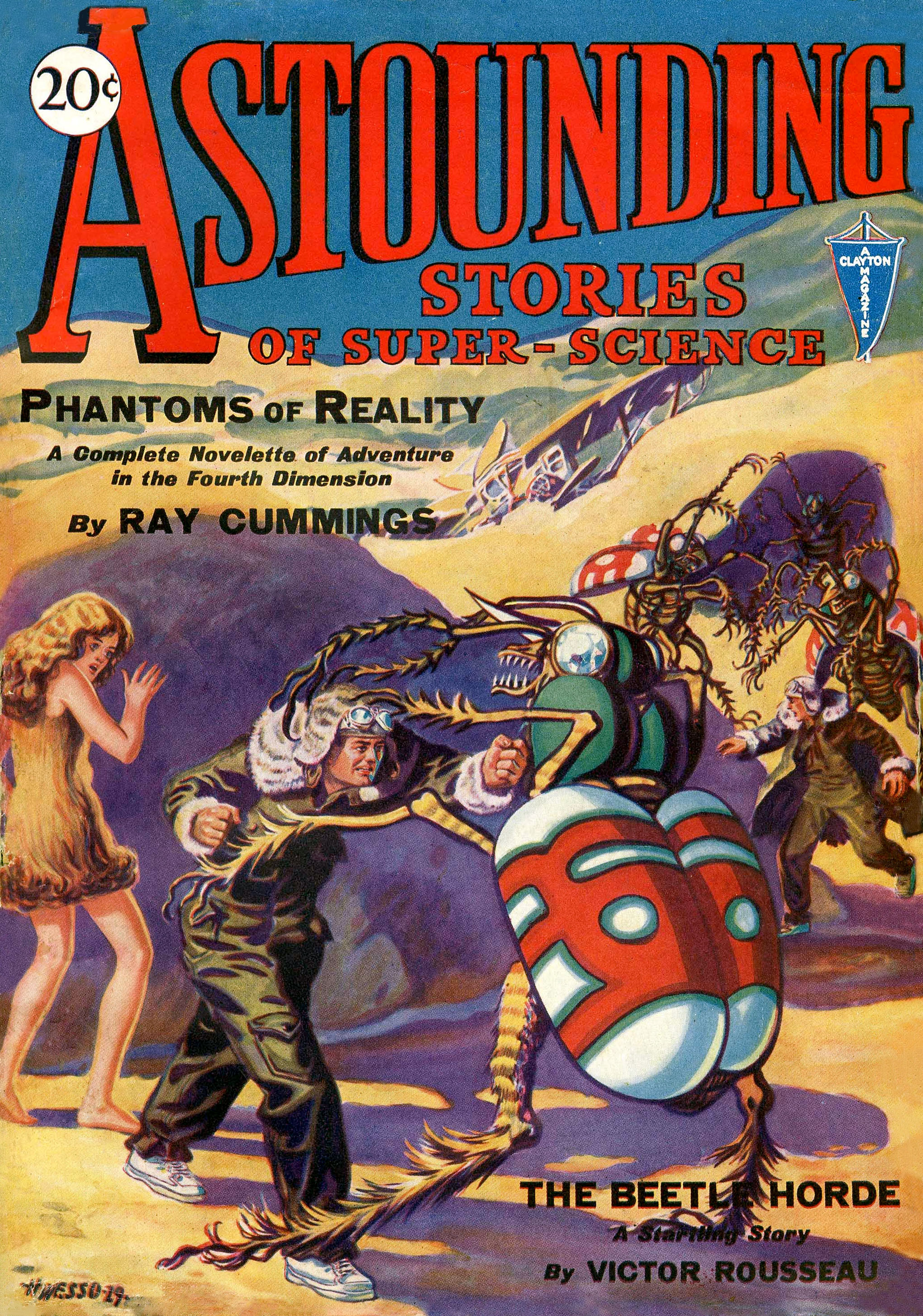
This is the first issue of Astounding Stories (now called Analog), an important magazine in the history of science fiction.


You can find the full text of the magazine at Project Gutenberg:  http://www.gutenberg.org/ebooks/41481


We will also continue our discussion of pulp stories and early magazine stories with Leslie F Stones "Conquest of Gola" --this is in the book but if you wish to see the actual magazine it came in (with editorials and other stories, as well as fascinating ads, you may look here: 


Large Thumbnail For Wonder Stories v2 11 - The Emperor of the Stars - Nat Schachner


In fact, a collection of on-line copies of all of the issues of "Wonder Stories" magazine from 1931 are here: http://www.pulpmags.org/content/view/issues/wonder-stories.html 


If you'd like to know more about Leslie Stone, http://www.sf-encyclopedia.com/entry/stone_leslie_f

Finally, I'd be curious to get your take on the issue of Edgar Rice Burroughs and sexism or lack thereof. 

There are ten and a half books in ERB's "Barsoom" (Mars) series, easily his most popular series after Tarzan and his most popular SF series.

This is the fourth one and dates from 1916. In the first three books, John Carter, a master swordsman and civil war veteran comes to Mars (Barsoom) through mysterious means where he discovers that due to the low gravity he has super strength. Skipping ahead, he makes friends with the savage four armed green martians who soon capture him and then rescues Dejah Thoris, a proud Barsoomian princess from a nation called Helium. They get married and have a son named Carthoris (should you wonder, Tarzan and Jane got married and had a son name Korak). 

In this book, Carthoris, now an adult, meets Thuvia, a proud Martian princess who has the power to control the Martian lions called "Banths" and well  . . . problems happen and he sets out to rescue her.  


Just read as much as you want but please try to read at least the first scene of the book. (It starts much faster than the first three. I think in the first one, it takes a couple chapters before John Carter gets to Mars, chapters in which ERB carefully explains how he met John Carter and acquired the manuscript and in which John Carter explains how he wound up on Mars after going to Arizona where he was chased by Apaches into some mysterious ruins that transported him to the red planet.

Description of book with 1916 cover


A more modern depiction of Thuvia painted by Brian Justo.


Images of Thuvia


The full text of the book is available online. 


Sunday, May 14, 2017

Teaching English 101 to low ability student, Part Two: English Punctuation is Important

In my last post, I described how I had come to teach English 101 at a for-profit vocational college that specialized in taking first generation college adult, often minorities, often with low academic ability and poor academic background and motivation, and hooking them up with loans and then enrolling them in its programs. What I've been told is that people like these programs because they often feature good good hands-on training in skills needed for different vocations. Unfortunately English 101, despite my attempts to make it relevant to real life, really didn't fit that bill particularly when many of the students were at the end of their programs, thereby making English 101 nothing more than a requirement to finish the program.


STEP ONE --THE PLAN

So what did I do on the first class? First, I decide to emphasize that one important aspect of good writing is that it is clear in meaning and comprehensible.

And one key to making English writing comprehensible is to use proper punctuation. Therefore, I did some google searching and found some entertaining.

I am offering these here for the benefit of others.


Domestic Examples:


20 Images That Prove Grammar and Punctuation Are Important


A Humorous Look at The Importance of Punctuation

29 Photos That Prove Punctuation Is VERY Important


Foreign examples

31 Brilliant examples of Engrish fails...


There was also this example from the humorous website Engrish.com that deals with Japanese and Asian examples of badly used English.


Having used some examples of bad English produced by Asians, I decided to avoid or reduce the likelihood of charges of racism (or "culturalism"? or "Anglocentrism"? Although I admit it is problematic and potentially offensive when one makes fun of usage of one's own language by non-native speakers, it is not necessarilly "racist" by the strict definition of "racism" now is it? Just saying.) by providing some exampes of bad Asian language usage by Westerners.

The most common example of where we see this is in tattoos using (or misusing) Chinese characters (or weird squiggles that are supposed to be Chinese characters). Since this is a subject that has interested me for years, it was easy enough to throw these in.


Google Search on bad Chinese tattoo fails


These presentations were followed up with showing a Cambodian language pop music video and asking students to write about it and a homework assignment. Before the next class, the students were to find one example of good writing and one example of bad writing.


STEP TWO --ASSESSING HOW THE LESSON WENT

This is a bit more problematic, but, of course, just as important if not more important than the actual lesson itself. What I often found, must to my surprise, was that many of the students read at such a low level that they were not able to grasp the lesson.  In other words, their knowledge of punctuation was such that the students were often unable to tell if a sentence were ambivalent or not.

I'm not sure how this should have been dealt with.

The obvious two solutions were to either assign homework that would focus on remedial punctuation or begin class with a lesson on remedial punctuation.

However, neither of these solutions worked well because the students who needed it the most, did not arrive in class on time nor did they do homework.

A hard nosed approach of "Do your homework or I will fail you," was tried and the administration was quick to tell me that they did not approve of this approach. (This is a common criticism of for-profit schools. Student happiness and retention of return customers is valued over academic rigor or standards.)

Teaching low level, low motivation students is not easy. It's an area where I hope to improve and am making efforts to improve and develop my teaching skills.

Thursday, May 4, 2017

An Introduction to Teaching English composition to low level adults -- My experiences.


In January of 2017, I was given the chance to teach English 101, Academic Writing and Research, at the local for-profit, vocational college. Although accredited by the Middle States Commission on Higher Education, this is one of those places that specializes in recruiting from often first generation, often minority, generally low academic level students who would not do well at other institutions, arranging for federal and other loans for them to enable them to complete their studies, and then running them through various programs focused on job and vocational training. The college also offers two year programs and, although English 101 is being phased out and replaced with a course oriented towards vocational and job needs than academic needs. 

At the time, however, not only did it exist, but it was a required course for some students who needed it to graduate in their programs. Curiously, unlike a normal college where students take English 101 first semester to develop the skills required to complete their studies and finish their program, at this school the majority of my students were in their last semester and had already completed the majority of their classes. This was particularly interesting as many of them showed serious academic deficits.  

At the last minute their previous English 101 instructor was unable or unwilling to continue and I was hired as a last minute replacement. In fact, they came to me, unsolicited, without my ever having applied to work at the school. 

Over the next few months, I found myself teaching academic writing to a small group of usually college age adults. There were ten students in the class, at the start, although one was later expelled, reducing the student load to nine. These students were all first college and their background proved a challenge to teaching. 

Over the next semester, I learned that in my class none of the students were aware of what a master's degree was, what a standardized test was, what the SAT's were, or who Steve Bannon, the controversial adviser to recently elected President Donald Trump, was. Nor, generally speaking, did they consider it abnormal or unusual that they didn't know these things, and generally had little interest in learning who or what they were.

Clearly, this was not the typical group of college students. And they had special challenges.

Most read at a low level. In many cases, they were not able to comprehend texts and newspaper articles unless given assistance, assistance they would often not ask for or seek out. It didn't help that the assigned textbook, as well as the verbiage on the syllabus, was far above their reading level, thus making the (quite expensive) textbook virtually useless for teaching. Although I can't discuss the exact rationale behind the inappropriate textbook or the syllabus, they both seemed to have been written for someone other than my students (and probably was). 

Why? It's difficult to say. Ability to use and write in standard English was also a challenge. One had a non-Western, South-West Asian language as his native language (he was also the hardest working and most studious student in the class.) Two others were Hispanic and although their English was at a high conversational level, I suspect one had problems stemming from his bilinguality. (To achieve in an academic setting, a student must be able to write and communicate at a sufficient level in the language of instruction, in this case English. This level is higher than that required for must mundane, day to day, workplace and social interactions. If a person has this level of ability in one language, for instance, most Chinese who come to the USA to study, they can often acquire it through education and study in a second language. With some bilingual students, they function at a non-academic level in two languages and then bringing them up to an academic level in either is a challenge that should ideally be addressed before placing them in a classroom. However in this case it had not been addressed.) The other attended class so rarely that I never did get a chance to really assess her English level thoroughly.  Another, although a native English speaker, spoke a "non-standard" Caribbean dialect of English as her native tongue,  

Which left six students who were native English speakers, but even these often showed problems. For instance, when I began my class with an assessment I like to use ( see: Assessing students writing through using Cambodian language pop music ) , two students, both White, native English speaking American women who spoke "working class English" turned in papers that included the line "Her and her friends were dancing." (as opposed to the more "standard"   "She and her friends were dancing.") 

For the next 15 weeks, each Wednesday for three hours I taught my class. Although I think my instincts were good, and I adjusted as time went on and I became more familiar with the expectations and restrictions of the administration and the abilities and level of motivations of the students, it was not an easy teaching assignment. 

To add to the challenges, while at most colleges English 101 -Academic Writing and Research is required in the initial semester or year so that the students develop an introduction to the skills that they will need to use to acquire their degree, in this case the course was being taken by many students near the end of their degree, students who expected to be entering fields where they would not need to do much academic research or writing, and who thus felt they had little practical need for the skills that were taught in the course.

Classes were often skipped, often attended late if at all, homework left undone, and the administration's approach to the problem was keep the students happy, do not confront them, and if they fail, well, they can take the class a second time --and be billed for it twice. 

Sunday, December 25, 2016

More Christmas Specials and Movies for English Language Learners and Foreign Students

Last time on this blog, I shared a few of the more common American Christmas specials. This time, I'll add a few more, as well as a couple of the best known Christmas films. These are all iconic Christmas specials well known in the USA and I introduced them in my advanced class a couple weeks ago.

# 5 -- A Charlie Brown Christmas 


Charlie Brown is most certainly an American icon. Seems like this should be included.


# 6 -- A Christmas Story

Last month in this class, as discussed in a post a few weeks ago on movies, I showed the Thanksgiving film, "Pieces of April," spread over a few weeks. I seriously considering give this film, "A Christmas Story," the same treatment and only decided against it as I did not wish to repeat myself with the same kind of class, two months in a row. Undoubtedly a good film for foreign folks wishing to understand American culture. --or at least American culture of a few decades ago.


#7-  It's a Wonderful Life 


A true classic and a well known one. Surely it can't help for people wishing to understand our culture to check this one out, can it?


# 8 - A Miracle on 34th Street 

The story of a "real" Santa Claus in New York City. Another classic worth checking out.


#9 -- Santa Claus Conquers the Martians  

Okay, here I might be pushing it. I admit this strange and bizarre classic in "bad" movies has a special place in my heart. On the other hand, I did show it to my students in the advanced class, a group primarily composed of educated, middle class Asian housewives and they seemed to consider the brief exposure ten minutes well spent.


Sunday, December 18, 2016

An Introduction to Christmas Special for "New Americans," Foreign Students, and ESL Students --Part One

Once a week, I teach an advanced ESL class where most of the students are wives of highly educated foreign workers, often from the tech industry. They generally speak English well and much of the class is cultural enrichment. 

What follows is a list of Christmas Specials that I introduced my students to this week. 

I began by explaining that Christmas is a religious holiday celebrated only by those who are at least nominally Christian and introduced the concept of separation of church and state. Nevertheless, I said, Christmas is clearly and important time of year and the separation of Church and State is not 100% (for better or worse) as evidenced by such things as "In God we Trust" on the money. 

So, with no further ado, a list of Christmas specials for ESL and Foreign Students. 


#1 --Frosty the Snowman

Although technically not a Christmas special, per se, this does tend to get shown around Christmas time. Therefore I began the class with it, perhaps to alleviate fears that I was going to push my religious beliefs or offend Muslims.   

Like many of these I began with the song on which the television special was based, and explained the vocabulary and concepts in it. Therefore I began with this song.    


I then followed up with the trailer for the TV show (or as close to the trailer as I could find. I am not convinced, despite the label, that this is really the TV show trailer.) 


#2 --Rudolph the Red Nosed Reindeer 


Again, I began with the song, explaining lyrics and vocabulary and cultural references. As an aside, and a piece of self criticism, this was not a terribly interactive lesson and was a bit lecture heavy. Not perfect, but once in a while, I feel, it's okay to do such lessons. 

 
This was followed by the trailer for the TV special. (This is not the one I used in class, but how can one not enjoy this? Especially if you are from Schenectady, home of GE, as I am. )


#3 - How the Grinch Stole Christmas 


This one I did a little differently than the others, because while the others started with songs, this one started with a book, a book by Dr. Seuss, so I began there. The I showed the trailer for the TV show. 


I explained that while I thought the word "grinch" had not been an English word, before this song they could now use it to describe an unhappy, grouchy person. I then followed this up with the song, explaining that a lot of the vocabulary is quite intense and obscure (I actually had to look up a couple words myself, "wasty" for instance, and told my students so. I do make it clear to my students that I do not understand every English word and they should not expect to be able to do so either. )


I showed this partly to explain the cultural significance of the song. I kind of feel they were more impressed than I was, but it was still fun to see the US Navy band perform this classic. 


This might have worked too, but probably not as well. 


And finally I introduced them to the Jim Carrey full length movie. I confess, I steered them away from it, but explained I hadn't seen it myself and perhaps I should before saying bad things about it. On the other hand, with the cartoon being such a classic, I feel this entire movie is unnecessary. Competely unnecessary. 


Sunday, November 27, 2016

Thanksgiving, Holidays, and Chinese New Year and such


Because it is shortly after Thanksgiving, one of the biggest and most group-oriented holidays in American society, it seems appropriate to write about how many foreign and English as a second language students view the holiday. The interesting truth is that it’s often surprisingly unimportant to them.

 Some who work with foreign students forget that Thanksgiving is a uniquely American holiday. (Okay, there actually is a Canadian Thanksiving held around Columbus day, but it lacks the same symbolism and significance.)

For instance, I once taught at a program at Tufts University that was intended to orient and prepare Chinese high school seniors for study at colleges and universities in the USA. Although I learned a lot in my time there, my feelings were that in many ways it was very much a program designed by and for American liberals without terribly much first hand understanding of Chinese culture and based in their preconceived notions of what the students should be taught rather than based on what the students actually needed. (Perhaps more on this another time.)

And one example of this was at a meeting early in the year,  someone announced that we must find places for them to spend time on Thanksgiving. The fear, as I understood it, was that they would become very lonely on the holiday if they did not have a place to go. However, few newly arrived Chinese students consider Thanksgiving to be terribly important. It is not a holiday celebrated in their country, and they did not grow up with it.  Instead they consider Chinese New Year (also known as Lunar New Year) to be the most important holiday of the year and both are celebrated with feasting and a gathering of families and communities. This is when Chinese, Taiwanese, and many other Asian students (including Vietnamese who celebrate Tet at this time of year) tend to get the most homesick and lonely.

By contrast, I remember my first Chinese New Year’s celebrated many years ago in Taipei, Taiwan, when I was in my early twenties and off to teach English as a Second or Foreign Language for the first time in Taiwan.

A group of us young foreign English teacher and student types gathered and enjoyed the way that the locals seemed to have abandoned their city and how it had become like a ghost town as people left to spend time with their families elsewhere.  The restaurants were closed so we ate canned fish and crackers and chatted and had a great time. We were not lonely at all, although my guess is that most of the Taiwanese we knew would have thought we were.

Some of us, including me, later had the opportunity to spend time with Taiwanese families and that was an enjoyable experience too, but it was something more along the lines of a cross-cultural educational experience than it was an experience based on joining a shared community for an important holiday.

We were much more on a “so what’s this crazy thing about anyway?” frame of mind than we were on a “how will we spend this important holiday?” vibe.

And that’s how many of your foreign students view Thanksgiving. If invited, they are happy. They meet new people. They see new things. They experience the host culture and learn more about its people and traditions.

However, if not they are usually fine.


By contrast, however, if one wish to care and provide well for your foreign students, you should learn what their holidays are and how they spend them and seek to ensure that they do not struggle with serious depression and homesickness during those times of year. 

Friday, November 18, 2016

Saudis and explaining same sex marriage

One of the challenges of teaching English as a Second Language is interacting with people from a wide variety of cultures. And of these cultures and students, some of the most challenging to deal with are often the Saudi Arabians.

Saudi Arabia is an oil rich nation dominated by conservative Islamic thought. (I mentioned Wahhabi-ism in a previous post.) It is a nation ruled by a king where the legal system is dominated by sharia law. It is the only nation in the world where women are prohibited from driving. ("Because we must protect them," explained a male Saudi to me casually one day.)

There are many Saudi Arabians coming to the USA to study these days. This is largely because the government of this nation is aware that some day their oil reserves and oil money will run out and that it is a good idea to diversify the country's economy by sending large numbers of students to the USA to study subjects that might prove useful in diversifying the economy. This is done through a Saudi government organization called SACM or the Saudi Arabian Cultural Mission. They approve schools, fund scholarships, and even, according to some reports, keep an eye on the students who come here to make sure they don't engage in activities that might be harmful to the Saudi government or royal family.

And when they come here, often they have questions about things they see or our culture. Sometimes these involve same sex marriage and homosexuality.

First, just to make it clear, many Saudi are under the impression that there is no homosexuality in their nation. Of course, this is absurd, and easily disproven. There are several articles (for instance
http://www.theatlantic.com/magazine/archive/2007/05/the-kingdom-in-the-closet/305774/ ) and documentaries ( see: https://www.google.com/search?sourceid=chrome-psyapi2&ion=1&espv=2&ie=UTF-8&q=documentary%20on%20homosexuality%20in%20saudi%20arabia&oq=documenta&aqs=chrome.0.69i59j0j69i57j0l3.8462j0j8 ) and other reports of homosexuality in Saudi Arabia, https://www.google.com/search?newwindow=1&espv=2&q=+homosexuality+in+saudi+arabia&oq=+homosexuality+in+saudi+arabia&gs_l=serp.12..35i39k1j0i7i30k1l3j0j0i30k1l2j0i8i30k1l2.72388.72388.0.75433.1.1.0.0.0.0.161.161.0j1.1.0....0...1c.1.64.serp..0.1.155.v4V99BFGdTQ )

Of course, homosexuality occurs in all cultures and societies in some form so why do many Saudis believe this? First, don't expect to see too many openly gay Saudis because (as the above sources explain) the penalty for engaging in gay sex in Saudi Arabia is to be stoned to death. Clearly, this kind of put a damper on any talk they had over there of organizing a gay pride parade, to say the least.

Secondly, the society often practices arranged marriages. Therefore even if a man or woman is gay they are quite likely to find themselves married to someone of the opposite sex no matter what their wishes might be.

For instance, one day I was teaching an intermediate ESL class in Boston. The lesson focused on the difference between "I hope to" and "I plan to" when speaking of events in the future. One Saudi student turned in the sentence "I plan to get married in two years."

I looked at it and asked "Do you have a girlfriend who wants to marry you?"

He said that he did not, and I asked "Well then, how do you know you will get married in two years?"

"My mother will find me a wife," he answered.

"Well, then," I said. "This is a good English sentence."

Obviously arranged marriages conceal people's natural sexual orientations.

So, this brings us to the million dollar question, what do you do when you are teaching your English as a Second Language class and a Saudi  raises his hand and asks "Is it true that two men here can get married?"

Your response may vary but here's mine.

First, try to sense out if he is really asking because he is confused and wishes to understand or if he is just looking for an excuse to argue, Some students, believe it or not, like to argue in class. If the student seems inclined to just make homophobic statements and argue that his culture is superior to American culture, I'd suggest that he and I save the conversation for after class and then cut it short if my suspicions proved correct.

If not you might wind up with an exchange similar to the following one I actually had:

Student: "But it is only disugsting and immoral men who do these things! If you can do this, what is to keep someone from marrying a dog?"

Me: "Hey, I've got a lot of gay friends and you don't even know them. Who are you to say they are disgusting?"

Even if you think there is some benefit to such shouting matches, and I doubt if there is, I hope you will agree that having them in front of an audience of ESL students benefits no one. If you must shout and call names, do it outside of the classroom.

Second, you could try the cultural relativism approach. I've tried it but in my experience, i
t doesn't work very well for reasons, I will illustrate below.

Student: Is it true that here two men can marry? In my country this would never be permitted.

Teacher: Well, yes, but different things are seen as ethical in different cultures. For instance, in your country it is considered okay to have more than one wife, but in our country it is not considered okay to do that. And in our country it is legal for two men or two women to get married, but in your country it is not. So you can see different cultures have different ways of doing things.

Student: Well, yes, but you must remember that what the Koran says is that a man can have three wives but he must treat them all equally, so that is why it is okay to have three wives.

Please understand that the student has now explained the teachings of the Koran and through that process now feels that he has explained right and wrong to the teacher. The teacher could go on to explain that most Americans do not follow the teachings of the koran or base their morality on it, but, personally, I would not do that in a classroom with several Saudis in it although I would be inclined to do so gently one on one outside of the classroom,

Regardless, few of the Saudi I've met seemed to be satisfied by an explanation of same sex marriage based cultural relativism.

Therefore, I now offer the solution to explaining this cultural difference to Saudi students.

First, a marriage, particularly an arranged marriage, is based on much more than sex and love.

It also an economic arrangement and a union designed to ensure that a household can be run in a smooth and workable fashion. Begin there.

Now picture a Saudi household. Who do you think does the dishes and mends the clothes? Why the woman, of course.

And who does the driving of the car? Why the man of course (unless, of course, they hire a foreign person as a driver which they often do but that's another issue)

So, if you have two men together as a couple what's one thing a Saudi needs to know?

Why who is going to do the dishes and mend the clothes, of course.

And in a lesbian couple who will drive the car?

Therefore what I have found works for me is that when Saudis ask about same sex marriage the place to start is with the division of household chores and duties. Explain that in an American marriage these are generally negotiated and not assigned by sex. Once a Saudi student can understand how the dishes get washed, how the floors get cleaned, and how the other mundane logistical duties involved in running  a family or a household get taken care of, then they are much closer to understanding how a same sex marriage might work.

This is the approach that I have found works for me. Try it for yourself and let me know how it works.  


Saturday, October 29, 2016

Use of Films in the ESL Classroom


Films in the ESL classroom, or any classroom for that matter, can be a good or bad thing.
Sometimes they can be a sign of laziness. Lazy? Yes and that’s bad.  If one gets the chance to see the amusing (but ultimately forgettable) film, “Bad Teacher,” Cameron Diaz plays the eponymous “Bad Teacher.” She hates her job and instead is focused on her life’s goal of raising funds for breast implants in order to better enable herself to catch a rich husband and never have to work again. (Yes, in this film Cameron Diaz wants breast implants. It’s not exactly the most thought-out, intelligent, or deepest film ever made. I only saw it once and while I did enjoy it, I have not seen it since.)

         Therefore, instead of actually teaching her English literature class,  she simply sits in the back of the room, snoozes, and plays movies each day. Each and every day. With no exceptions or any other activities of any kid.

          She is, as the title says, a bad teacher. (By the way, I have never used this film in the classroom. I doubt very much if I ever will. )


           Don’t be a bad teacher. Don’t show films each and every day in your ESL classroom.
But does this mean you can’t use any films at all in the classroom? No, of course not.  There are many ways to show films in the classroom and do so in a way where you remain an active, engaged teacher and your students benefit from the activity.

           Over the years, I have used several films in my classrooms. The tip to using them successfully, I feel is to choose a film that is useful and relevant to the student’s interests, concerns, and goals. It should go without saying that it is best to choose a film that will not offend and will make students comfortable in the classroom. Then stop and teach from it.  In other words, 15 to 20 minutes of film per class with the film spread over several classes is not a bad way to do it.

            It is a good idea to prepare ahead of time

Consider handouts or at least make a list of the following that students will gain from the film:
  • ·         Vocabulary
  • ·         Idioms
  • ·         Cultural references and customs


Discuss these. You might wish to have supplemental materials prepared ahead of time.

          Of course, it helps to know your students. In my last class, we started watching the film, “Pieces of April.” This small independent film involves a dysfunctional family that tries to get together for one last Thanksgiving together because mom is dying from cancer. April, the problem daughter, has invited everyone to her place for Thanksgiving dinner. There are only two problems, the first is April really does not know how to cook. The second is that when she does sit down and get ready to roast her turkey, she discovers that her stove is broken and the finds herself running up and down the stairs of her run-down apartment building desperately asking people if she can borrow an oven on Thanksgiving morning.  


            In the film people speak relatively standard American English but the idiom “nip it in the bud” as in “I am nipping this in the bud right now” needed to be taught.

             As the film is from 2004 the reference to “collect calls” and “calling collect” needed to be explained.

            Curiously the phrase, “Eddy the drug dealer is history” which is used when the father is trying to give reasons as to why they should be optimistic about April’s life and their upcoming visit, was quite confusing to the students.

             When it was all over, they had many questions, but a surprising number of them were about how to properly cook a thanksgiving turkey with stuffing. Next week I hope to bring some youtube videos on how best to prepare a Thanksgiving turkey.     
A few other films, I have used in the ESL classroom include:

Bright Lights, Big City


Hair Spray


My Name is Earl –Sold a Lemon Car (Season 4, Episode 9) 


Sunday, October 23, 2016

Halloween and Pre-Christian Influence on English and English speaking cultures. ESL lesson

Pagan or Pre-Christian influence on English and the English-speaking or "Western" society are subjects little covered in ESL curriculum. As Halloween, a holiday with pre-Christian origins, is  coming and the students as me to talk about it I decided that this would make a good subject for my advanced ESL class at William K. Sanford Town Library.

I focused on several different topics and loosely linked them together.

The first was a rough map of Europe circa 800AD (ish) on which I had marked the lands of the Celts  or Celtic peoples as well as the Vikings / Norse and a big circle labelled German tribes.

I pointed at the circular area labelled "Celtics" and asked if anyone knew the name of the Boston professional basketball team. (the "Celtics") and waited for answers. Some guessed "Red Sox" and there were other guesses but soon I just went to google and typed "boston professional basketball" on the board.

Then I decided to talk and teach a bit about the history of the English language. I used three youtube videos for this.

Old English poem of the Battle of Brunanburgh

This is interesting, but, of course, there's no need to play the whole thing.

How Far Back in Time Could You Go and Understand English?

Quite good, but I take exception to the portion where they refer to the King James Version of the Bible as "the Bible" (It is one of many versions of the Bible, not "THE" version of the Bible.)

Old English Greetings

This one is a bit amateurish, I thought (not how he often seems to be reading from cue cards) but it is kind of fun. Also there is the portion where he teaches the phrase "Gode Niht" or "Good night" and pronounces "niht" sort of as "ni ccckk t" with a sound like the German or Scottish "ch" in "ach!" --this is a good place to address those pesky, oddball "gh" letters that keep cropping up in English spelling.

i.e. night, knight, through, rough, though, etc.

In all of these words, the "gh" was originally a "ch"as in the Scottish or German pronunciation of the "ch" and, by the way, it is my undertanding that all of the "ough" s at one time ha d a uniform pronunication a bit like "ooooooccckkk" but with the German / Scottish "ch" on the end.

Also worth noting, and again these were very advanced students, I would not do this with lower level students, is the way in which some English words show plurality with a vowel shift instead of an attached "s."  i.e. man/ men, woman/ women, tooth / teeth, foot / feet, mouse/ mice, etc. I just found it interesting that the roots of this practice lie back in the British languages.

I also, just in passing, mentioned Gaelic and Welsh.

I showed clips from Ashley MacIsaac and Mary Jane Lamond's 1990s version of "Sleepy Maggie." I noted that it is in Gaelic and not English and said, truthfully, that it was once one of my favorite songs.
https://www.youtube.com/watch?v=aoApELfgWcg

The students were a little confused by the role of Gaelic but a segment or two from this delightful short film, Yu Ming is Ainm Dom, put it in perspective for them.
https://www.youtube.com/watch?v=JqYtG9BNhfM

There's a wonderful part where a Chinese man who has learned Irish Gaelic actually tries to use it in a bar in Ireland. It's about 8:00 minutes into the film.


Next we got to the part on some pre-Christian / Pagan influences on our society.

These were, first, the "strange" practice of "knocking on wood" for luck.

https://www.youtube.com/watch?v=Dc4khyR6yBk

I explained that although this custom had origins in a belief in tree spirits and tree gods. I also mentioned that most Americans do not know this and I had only learned it when I was about 27 years old from a friend.

I then went to the names of the days of the weeks.

While Sunday and Monday are named after the Sun and the Moon respectively, the other five days of the week are named after pagan / pre-Christian god.

Tuesday, Wednesday, Thursday, and Friday are named after the Norse / Viking gods Tyr, Wodin, Thor, and Freya respectively. I used Google images to explain and show pictures of who they all were and, of course, mentioned the Marvel Comics film. I also mentioned that now they knew why there was a "d" in the middle of the word for "Wednesday."

Of course, i had to share this too.


I also mentioned that the names of the planets came from Roman Gods.


And then, and only then, did I actually get into Halloween which I explained with this video. I did stop the video from time to time to clarify or explain a point. 


I then mentioned the Easter bunny and Easter eggs (pre-Christian influences) and Santa's elves, another sort of pre-Christian borrowing. 

To finish the class and give the students a chance to talk to each other and not just listen to me, I asked them to offer their solutions to the following advice column questions, each of which had a Halloween theme. 


http://www.dispatch.com/content/stories/life_and_entertainment/2015/10/11/1-cowgirl-right-to-speak-up-about-halloween-costume.html

http://www.uexpress.com/dearabby/2014/10/19/cheap-candy-might-work-magic-on


http://www.uexpress.com/dearabby/2014/10/20/halloween-cowgirl-can-leave-her-pistol

This one I did not actually use in class as it contained sexual content but I did find it funny. 

http://www.uexpress.com/dearabby/2014/12/10/wifes-birthday-gag-gift-turns-out

Friday, October 7, 2016

Dear Abby -- The English (or busy and over-worked) English teacher's friend.


Dear Abby -- The English (or busy and over-worked) English teacher's friend.
Advice columns such as Ann Landers or Dear Abby.
Show them to students, cover the answers, and ask them what they would do.

DEAR_ABBY_12880069-e1420416724734-655


Very useful but you must read them in advance or you may find (to your surprise and shock) that they contain sexual situations or other situations that you do not wish to discuss in class.


http://chicago.suntimes.com/lifestyles/dear-abby-after-7-years-should-we-wed-or-wait/