Friday, October 13, 2017

Pete Teaches Science Fiction --Class #4


Next week in honor of the release of Blade Runner 2049, a sequel to Blade Runner which is based on the novel "Do Androids Dream of Electric Sheep?" by Philip K Dick, we'll skip ahead and talk about Philip K Dick. 

We plan to read "Beyond lies the wub" which is in the book.

If you prefer to read it online, it's easily available online.

http://www.gutenberg.org/files/28554/28554-h/28554-h.htm

It would also be nice if you read one other thing by him. On line stories are here. 


a list of movies is here: 


Please be aware that the movies tend to slide away from the philosphical aspects of the work and more into action but that's the nature of movies. 


There are a lot of good documentaries and biographical materials available on Philip K Dick. The challenge for this class was to find one that was short ehough so that it did not take up all our class time. 


Here's some more biographical material on Philip K Dick.


This is an interesting discussion of the film adaptations of Philip K Dick


However, this is the best documentary I have seen yet on Philirp K Dick. Unfortunately, it's an hour long so we won't be watching it in class, but I definitely recommend you take a look at it if you have the time. 


Philip K Dick is a very interesting and controversial writer. 


In class, I will very quickly share some thoughts on Philip K Dick that came from Stephen Miller, a science fiction writer. Miller and his wife, Sharon Lee, are very nice people who write a space opera series set in what they call "The Liaden Universe." Their website is here: http://korval.com/  Their work is very, very different from Philip K Dick's.  

In the above documentary, "Phiiip K Dick, A Day in the Afterlife," Thomas Disch is featured prominently. He is a science fiction writer who also wrote an interesting book on science fiction called The DREAMS OUR STUFF IS MADE OF: How Science Fiction Conquered the World. Although the book is far reaching and discusses many things, Philip K Dick is often discussed in it and in many contexts

https://www.amazon.com/DREAMS-OUR-STUFF-MADE-Conquered/dp/0684859785/ref=sr_1_fkmr0_1?s=books&ie=UTF8&qid=1507927248&sr=1-1-fkmr0&keywords=disch+stuff+our+dreams+are+made+of

Thursday, October 12, 2017

Pete Teaches Science Fiction --Class #3

The Early Magazines  --

"The Pulps" 


This site provides an excellent introduction to the "pulp" magazines that were such an important part of early science fiction: https://mail.google.com/mail/u/0/#inbox/15f12ccdc5ad3bc9

While there, do not hesitate to browse and explore the archives. Many of the early pulp magazines are on the web in different places.


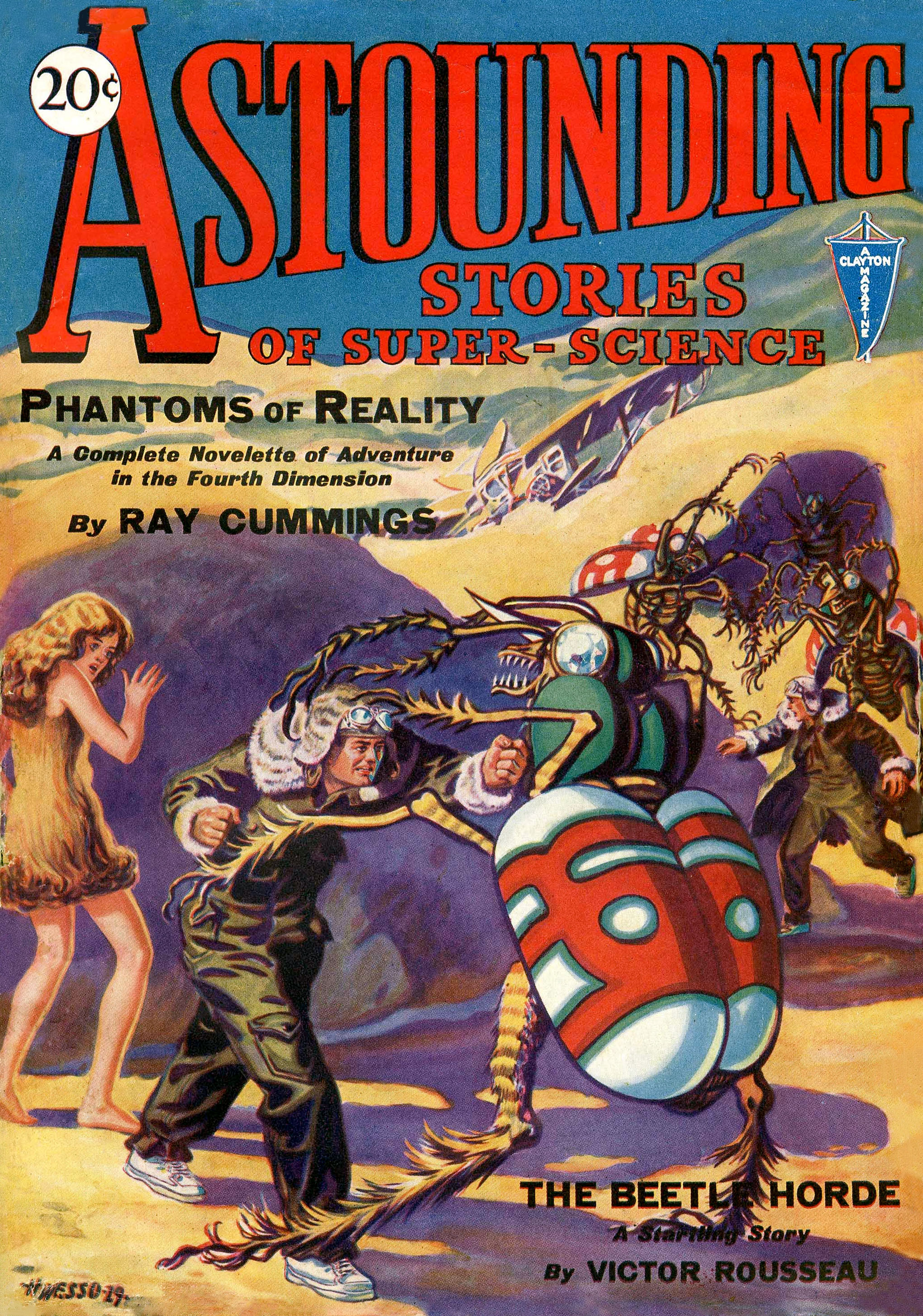
This is the first issue of Astounding Stories (now called Analog), an important magazine in the history of science fiction.


You can find the full text of the magazine at Project Gutenberg:  http://www.gutenberg.org/ebooks/41481


We will also continue our discussion of pulp stories and early magazine stories with Leslie F Stones "Conquest of Gola" --this is in the book but if you wish to see the actual magazine it came in (with editorials and other stories, as well as fascinating ads, you may look here: 


Large Thumbnail For Wonder Stories v2 11 - The Emperor of the Stars - Nat Schachner


In fact, a collection of on-line copies of all of the issues of "Wonder Stories" magazine from 1931 are here: http://www.pulpmags.org/content/view/issues/wonder-stories.html 


If you'd like to know more about Leslie Stone, http://www.sf-encyclopedia.com/entry/stone_leslie_f

Finally, I'd be curious to get your take on the issue of Edgar Rice Burroughs and sexism or lack thereof. 

There are ten and a half books in ERB's "Barsoom" (Mars) series, easily his most popular series after Tarzan and his most popular SF series.

This is the fourth one and dates from 1916. In the first three books, John Carter, a master swordsman and civil war veteran comes to Mars (Barsoom) through mysterious means where he discovers that due to the low gravity he has super strength. Skipping ahead, he makes friends with the savage four armed green martians who soon capture him and then rescues Dejah Thoris, a proud Barsoomian princess from a nation called Helium. They get married and have a son named Carthoris (should you wonder, Tarzan and Jane got married and had a son name Korak). 

In this book, Carthoris, now an adult, meets Thuvia, a proud Martian princess who has the power to control the Martian lions called "Banths" and well  . . . problems happen and he sets out to rescue her.  


Just read as much as you want but please try to read at least the first scene of the book. (It starts much faster than the first three. I think in the first one, it takes a couple chapters before John Carter gets to Mars, chapters in which ERB carefully explains how he met John Carter and acquired the manuscript and in which John Carter explains how he wound up on Mars after going to Arizona where he was chased by Apaches into some mysterious ruins that transported him to the red planet.

Description of book with 1916 cover


A more modern depiction of Thuvia painted by Brian Justo.


Images of Thuvia


The full text of the book is available online. 


Tuesday, October 10, 2017

Pete Teaches Science Fiction --Class #2

Early writers

 Science Fiction Writers!
 Science Fiction Writers? 

Jules Verne

1828-1905 

"Voyage Extroadinaire" / Extraordinary Voyages

French adventure writer who enjoyed writing stories that include a technological wonder


Homer??

Odyssey? Illiad?


Could Homer have believed cyclopses really existed? See L. Sprague De Camp's interesting non-fiction book, "Lands Beyond."


H.G. Wells

1866-1946

Socialist with pacifist leanings 

Wrote science fiction which said something about society. 

War of the Worlds imagery 


Jonathan Swift Gulliver's Travels??

Political satire?? 


Edgar Rice Burroughs

1875-1950

American, the escapist, heroic branch of science fiction

Art based on Edgar Rice Burroughs fiction


Image result for edgar rice burroughs art


Sunday, October 8, 2017

Teaching English 101 to low ability students: developing a research topic


Because students often did not attend class, and the text book was not appropriate to their reading level, I made an effort to provide the materials required in a way that the students could access them any time and any place they might wish. Fortunately youtube offers a wealth of such materials.

Since part of learning to do academic writing, or any sort of writing for that matter, is to choose an appropriate topic and develop it in an appropriate way, I devoted a class to that topic.

When it comes to research paper topics, there's a lot of fine materials out there and here are some of my favorities.

As with most writing topic, the Purdue Owl contains useful materials:

https://owl.english.purdue.edu/owl/resource/658/03/

But youtube has many materials as well. 


Saturday, September 23, 2017

Frankenstein --Pete Teaches Science Fiction -Class #1


I recently had the chance to teach a non-credit class on science fiction at the local engineering school. Of course, I accepted. And, although we've only completed three weeks I am enjoying myself and so are the students, I think.

Class #1 was devoted to the question of "Can one define what science fiction is?" and "What is the first Science Fiction story?"

I don't claim it's a definitive answer, but I chose Mary Shelley's Frankinstein as my answer.

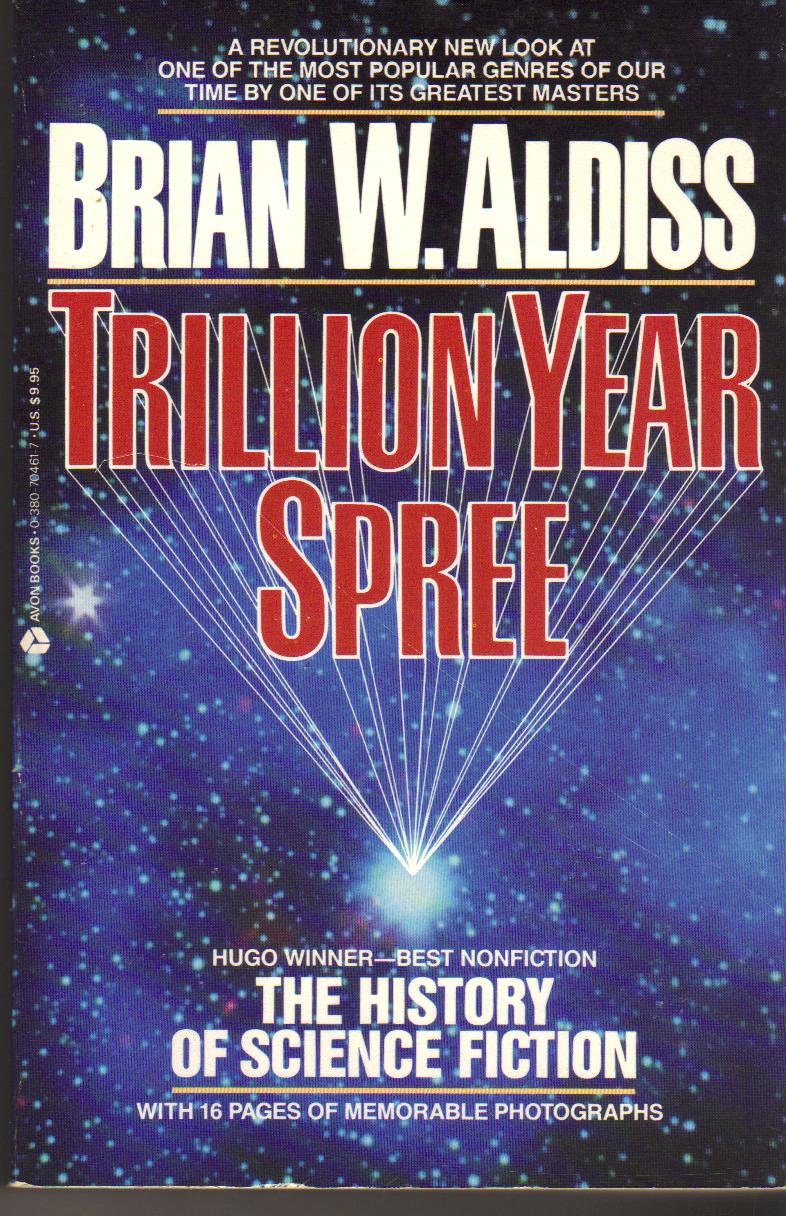
In fact, I completely admit I took this answer from Brian Aldiss's wonderful book, "Billion Year Spree."
https://www.amazon.com/Trillion-Year-Spree-History-Science/dp/0380704617/ref=sr_1_1?s=books&ie=UTF8&qid=1507513805&sr=1-1&keywords=trillion+year+spree+the+history+of+science+fiction


A wonderful book well worth reading and in much need of an update.


So here's a bit on Frankenstein, or the Modern Prometheus by Mary Shelley.

The story of the writing of Frankenstein is fascinating but has also been documented many times before.

For instance see:
http://www.history.com/this-day-in-history/frankenstein-published

or
http://www.thedailybeast.com/the-summer-storm-that-inspired-frankenstein-and-dracula


This entertaining and well done video includes much on that subject, although I prefer to stop the video at about the point roughly half way through where the SPOILERS  on this classic novel (much different from the films) start:


Mary Shelley's Frankenstein (as well as Pollidori's much forgotten but highly influential novel, "The Vampyre.") were written on a particularly wild weekend by a group of decadent Bohemians including Lord Byron, the poet, and Mary's husband Shelley, another decadent, wild poet.

I'd heard there was a movie based on this weekend and the events that occurred. To my surprise, I learned there were two. interestingly, they were made only two weeks apart. "Haunted Summer" and "Gothic" --interestingly I stumbled across a bizarre looking film called "Liztomania" that was also produced by Ken Russel, producer of "Gothic."

Although "Liztomania," had nothing but nothing to do with anything related to the class, save for some bizarre science fiction imagery, I showed it to the students and they seemed to enjoy it.


http://www.imdb.com/title/tt0095280/


http://www.imdb.com/title/tt0091142/


Liztomania by Kurt Russel


https://www.google.com/search?q=Franz+Liszt&oq=Franz+Liszt&aqs=chrome..69i57&sourceid=chrome&ie=UTF-8

http://www.imdb.com/title/tt0073298/

=============
Finally, for students who wished to find the text of Mary Shelley's Frankenstein, it's on line in several places.

http://www.gutenberg.org/ebooks/84?msg=welcome_stranger

http://www.gutenberg.org/ebooks/6087


Sunday, May 14, 2017

Teaching English 101 to low ability student, Part Two: English Punctuation is Important

In my last post, I described how I had come to teach English 101 at a for-profit vocational college that specialized in taking first generation college adult, often minorities, often with low academic ability and poor academic background and motivation, and hooking them up with loans and then enrolling them in its programs. What I've been told is that people like these programs because they often feature good good hands-on training in skills needed for different vocations. Unfortunately English 101, despite my attempts to make it relevant to real life, really didn't fit that bill particularly when many of the students were at the end of their programs, thereby making English 101 nothing more than a requirement to finish the program.


STEP ONE --THE PLAN

So what did I do on the first class? First, I decide to emphasize that one important aspect of good writing is that it is clear in meaning and comprehensible.

And one key to making English writing comprehensible is to use proper punctuation. Therefore, I did some google searching and found some entertaining.

I am offering these here for the benefit of others.


Domestic Examples:


20 Images That Prove Grammar and Punctuation Are Important


A Humorous Look at The Importance of Punctuation

29 Photos That Prove Punctuation Is VERY Important


Foreign examples

31 Brilliant examples of Engrish fails...


There was also this example from the humorous website Engrish.com that deals with Japanese and Asian examples of badly used English.


Having used some examples of bad English produced by Asians, I decided to avoid or reduce the likelihood of charges of racism (or "culturalism"? or "Anglocentrism"? Although I admit it is problematic and potentially offensive when one makes fun of usage of one's own language by non-native speakers, it is not necessarilly "racist" by the strict definition of "racism" now is it? Just saying.) by providing some exampes of bad Asian language usage by Westerners.

The most common example of where we see this is in tattoos using (or misusing) Chinese characters (or weird squiggles that are supposed to be Chinese characters). Since this is a subject that has interested me for years, it was easy enough to throw these in.


Google Search on bad Chinese tattoo fails


These presentations were followed up with showing a Cambodian language pop music video and asking students to write about it and a homework assignment. Before the next class, the students were to find one example of good writing and one example of bad writing.


STEP TWO --ASSESSING HOW THE LESSON WENT

This is a bit more problematic, but, of course, just as important if not more important than the actual lesson itself. What I often found, must to my surprise, was that many of the students read at such a low level that they were not able to grasp the lesson.  In other words, their knowledge of punctuation was such that the students were often unable to tell if a sentence were ambivalent or not.

I'm not sure how this should have been dealt with.

The obvious two solutions were to either assign homework that would focus on remedial punctuation or begin class with a lesson on remedial punctuation.

However, neither of these solutions worked well because the students who needed it the most, did not arrive in class on time nor did they do homework.

A hard nosed approach of "Do your homework or I will fail you," was tried and the administration was quick to tell me that they did not approve of this approach. (This is a common criticism of for-profit schools. Student happiness and retention of return customers is valued over academic rigor or standards.)

Teaching low level, low motivation students is not easy. It's an area where I hope to improve and am making efforts to improve and develop my teaching skills.

Thursday, May 4, 2017

An Introduction to Teaching English composition to low level adults -- My experiences.


In January of 2017, I was given the chance to teach English 101, Academic Writing and Research, at the local for-profit, vocational college. Although accredited by the Middle States Commission on Higher Education, this is one of those places that specializes in recruiting from often first generation, often minority, generally low academic level students who would not do well at other institutions, arranging for federal and other loans for them to enable them to complete their studies, and then running them through various programs focused on job and vocational training. The college also offers two year programs and, although English 101 is being phased out and replaced with a course oriented towards vocational and job needs than academic needs. 

At the time, however, not only did it exist, but it was a required course for some students who needed it to graduate in their programs. Curiously, unlike a normal college where students take English 101 first semester to develop the skills required to complete their studies and finish their program, at this school the majority of my students were in their last semester and had already completed the majority of their classes. This was particularly interesting as many of them showed serious academic deficits.  

At the last minute their previous English 101 instructor was unable or unwilling to continue and I was hired as a last minute replacement. In fact, they came to me, unsolicited, without my ever having applied to work at the school. 

Over the next few months, I found myself teaching academic writing to a small group of usually college age adults. There were ten students in the class, at the start, although one was later expelled, reducing the student load to nine. These students were all first college and their background proved a challenge to teaching. 

Over the next semester, I learned that in my class none of the students were aware of what a master's degree was, what a standardized test was, what the SAT's were, or who Steve Bannon, the controversial adviser to recently elected President Donald Trump, was. Nor, generally speaking, did they consider it abnormal or unusual that they didn't know these things, and generally had little interest in learning who or what they were.

Clearly, this was not the typical group of college students. And they had special challenges.

Most read at a low level. In many cases, they were not able to comprehend texts and newspaper articles unless given assistance, assistance they would often not ask for or seek out. It didn't help that the assigned textbook, as well as the verbiage on the syllabus, was far above their reading level, thus making the (quite expensive) textbook virtually useless for teaching. Although I can't discuss the exact rationale behind the inappropriate textbook or the syllabus, they both seemed to have been written for someone other than my students (and probably was). 

Why? It's difficult to say. Ability to use and write in standard English was also a challenge. One had a non-Western, South-West Asian language as his native language (he was also the hardest working and most studious student in the class.) Two others were Hispanic and although their English was at a high conversational level, I suspect one had problems stemming from his bilinguality. (To achieve in an academic setting, a student must be able to write and communicate at a sufficient level in the language of instruction, in this case English. This level is higher than that required for must mundane, day to day, workplace and social interactions. If a person has this level of ability in one language, for instance, most Chinese who come to the USA to study, they can often acquire it through education and study in a second language. With some bilingual students, they function at a non-academic level in two languages and then bringing them up to an academic level in either is a challenge that should ideally be addressed before placing them in a classroom. However in this case it had not been addressed.) The other attended class so rarely that I never did get a chance to really assess her English level thoroughly.  Another, although a native English speaker, spoke a "non-standard" Caribbean dialect of English as her native tongue,  

Which left six students who were native English speakers, but even these often showed problems. For instance, when I began my class with an assessment I like to use ( see: Assessing students writing through using Cambodian language pop music ) , two students, both White, native English speaking American women who spoke "working class English" turned in papers that included the line "Her and her friends were dancing." (as opposed to the more "standard"   "She and her friends were dancing.") 

For the next 15 weeks, each Wednesday for three hours I taught my class. Although I think my instincts were good, and I adjusted as time went on and I became more familiar with the expectations and restrictions of the administration and the abilities and level of motivations of the students, it was not an easy teaching assignment. 

To add to the challenges, while at most colleges English 101 -Academic Writing and Research is required in the initial semester or year so that the students develop an introduction to the skills that they will need to use to acquire their degree, in this case the course was being taken by many students near the end of their degree, students who expected to be entering fields where they would not need to do much academic research or writing, and who thus felt they had little practical need for the skills that were taught in the course.

Classes were often skipped, often attended late if at all, homework left undone, and the administration's approach to the problem was keep the students happy, do not confront them, and if they fail, well, they can take the class a second time --and be billed for it twice.